

There’s a scene in the Dan Barber episode of Chef’s Table where he’s standing in a field holding a carrot and he’s clearly having a genuine moment of discovery. Not performing it. Actually discovering something. And the reason he can do it is because he’s in the field every morning.
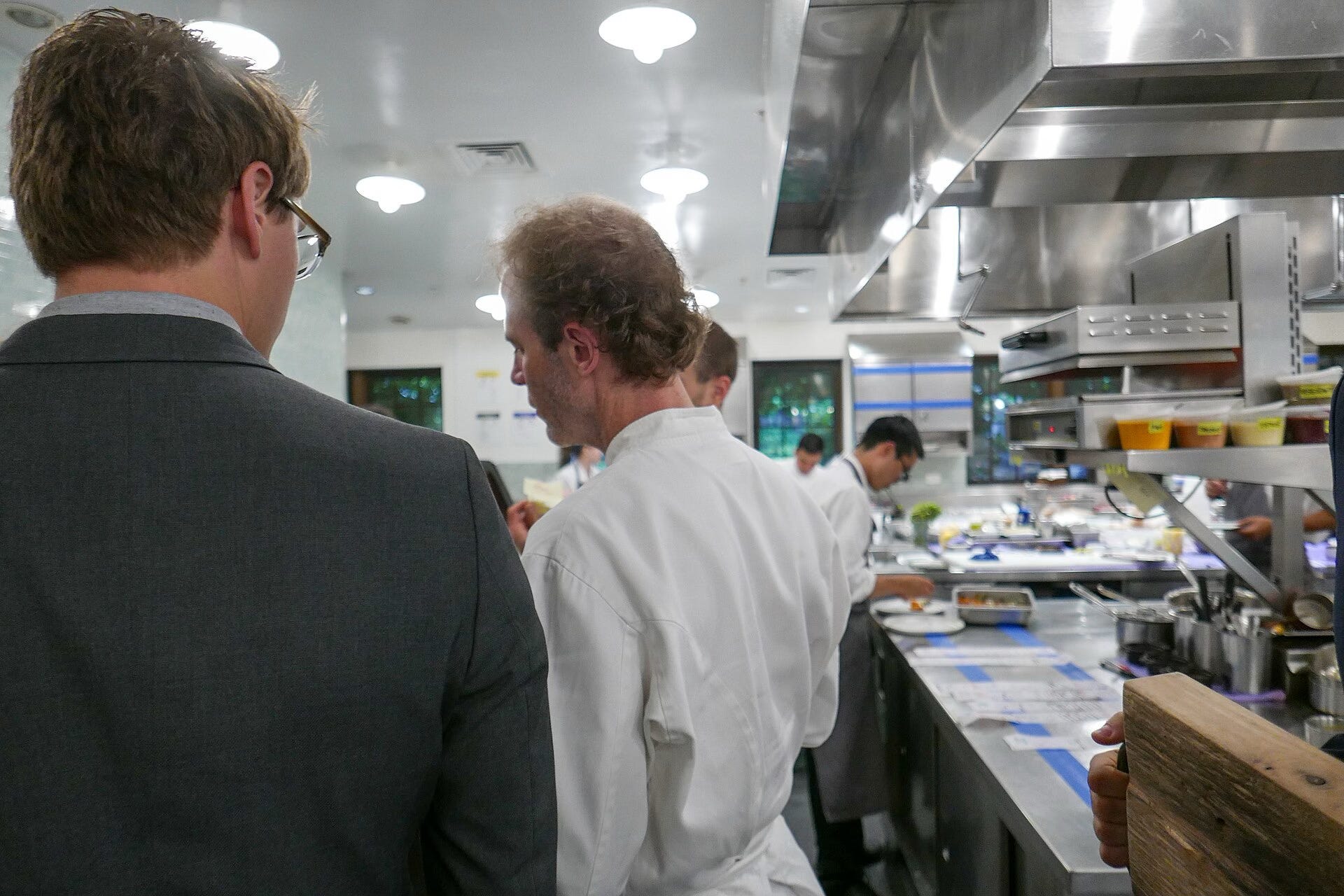
Blue Hill at Stone Barns doesn’t have a fixed menu. Barber walks the farm before service, meets with growers to find out what’s peaked or what’s unexpectedly ready, and builds that evening’s dinner around those conversations. The farm is telling him something specific on that Tuesday morning and the menu reflects it. Not what he planned to cook, not what he assumed diners would want. What the farm is telling him today.
I know the farm-to-table thing has been hollowed out so thoroughly by marketing that it’s basically meaningless now. But what Barber’s doing is almost anthropologically different. The farmers aren’t vendors optimised for consistency. They’re creative partners. And the collaboration runs both ways: sometimes they tell him about something he’s never seen before and it changes what he cooks that night. Sometimes he tells them what he wishes he had and they work on growing it. It’s a feedback loop built on mutual investment, not purchase orders.
Most product organisations treat research participants the way commodity supply chains treat farmers. You extract information, you get what you need, you move on. There’s a professional distance that functions as a kind of coldness, and there’s this point where research stops being a conversation and becomes just data collection.
Here’s what actually interests me though. The reason Barber can run his restaurant this way is because research is the operating rhythm, not a phase that precedes the real work. There’s no discovery sprint in Q2, a handoff to execution in Q3, and a post-launch analysis in Q4. There’s a morning meeting, and then dinner is different because of it. The menu changes because a conversation happened. The thing you build tomorrow is shaped by what you learned this morning, from actual interaction with the actual thing, not from a research summary compiled three months ago.
Compare that to how most organisations do this. Discovery phase, maybe four to eight weeks of user interviews. Then strategy, then execution, then shipping. Research has dates, it has deliverables, it exists as a separate activity. I’ve been in organisations that treat discovery like you’ve unlocked a level and now you move on to the building level where you don’t need to talk to users anymore because you already have the insights. The insights are done. You can put them away now.
The honest version of this critique, and I’m not immune to it, is that we’ve made a choice to organise around shipping plans instead of staying close to what’s actually needed. And the choice made sense once, maybe, but now we keep making it out of habit.
The counterargument writes itself: Barber can serve a different menu every night because diners can’t sue him for changing the second course. A SaaS product has consistency constraints because your users are expecting roughly the same product on Thursday that they opened on Tuesday. You can’t just respond to every conversation in real time and rebuild the thing. Fair.
But the version I find harder to argue with is this: there’s a gap between “we talk to users regularly” and “we actually let what users tell us reshape what we’re building in the moment.” And that gap is enormous in most product organisations. Not because we’re not doing research. Because the research lives in a separate tool, or a folder, or a post-launch report, rather than being woven into how the work actually happens. The research isn’t the operating rhythm. It’s the thing that interrupts the operating rhythm.
Marty Cagan wrote a whole book about continuous discovery and it’s a good book. But watching Barber describe his morning routine made it click in a way that book never quite did. The difference, I think, is that Cagan is writing about how product discovery should be organised, and Barber is just doing it. He’s not thinking about the philosophy of being close to the farm. He’s trying to cook dinner with the best ingredients available, and the rest of the system emerged from that constraint.
That’s probably the part that’s hardest to import. It’s not a methodology, it’s a disposition. The menu changes because someone walked into a field, tasted something, and let that reshape the evening’s plan. Not because a roadmap review said it was time to add carrots to the rotation.
Part 3 of 7. Previously: Massimo Bottura, and why reframing is harder than inventing something new. Next: Niki Nakayama, on experience design as conversation.