
Your Product Process is the Problem
The frameworks keeping your team safe are the same ones keeping it mediocre.

Lewis Hyde’s Trickster Makes This World is a book about mythology, about Hermes and Coyote and Loki, but the thing it’s really about is this: every culture eventually hardens into a set of rules about what belongs where, what counts as acceptable, what gets called a good idea. And then it slowly suffocates on those rules. Hyde’s argument is that the only thing that saves a culture from that fate is the Trickster, the figure who lives at the edge of the map and keeps crossing lines that everyone else agreed to respect. Reading it, I couldn’t stop thinking about product teams.
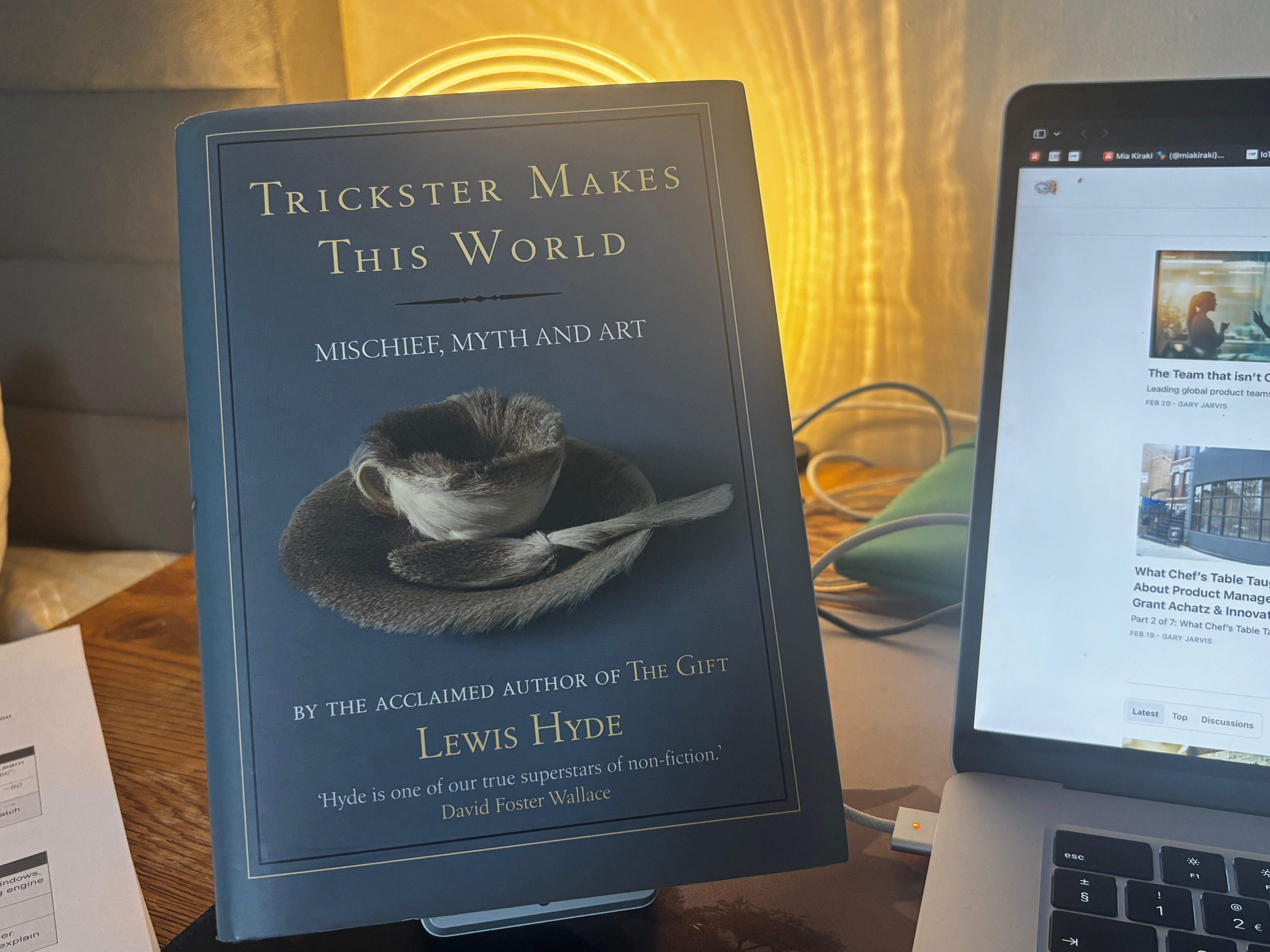
The parallel is not comfortable. Hyde describes organisations that have mistaken their frameworks for reality, that have drawn so many lines around what counts as a valid problem, a rigorous process, a defensible decision, that they’ve quietly sealed themselves off from anything new. That’s not a description of a broken team. That’s a description of most teams, including ones I’ve been proud to work on. The OKR, the roadmap, the stage-gate process, none of it is wrong exactly. But it hardens, and once it hardens, people stop making decisions based on what’s true and start making decisions based on what the system will accept. I’ve done this.
The first thing Hyde teaches you is that genuine ideas feel wrong before they feel right. The Trickster doesn’t innovate from inside the existing order. He steals from outside it, brings something back from a place it wasn’t supposed to come from, and the friction of that wrongness is precisely the source of the energy. For example… Picasso and the African masks. The reason this move felt scandalous is the same reason it mattered. That quality in a product idea, the one that makes it hard to write up in a business case, hard to get through a roadmap review without someone asking for more data, that’s not a sign the idea is weak. It’s a sign it’s come from somewhere outside the current order. That feeling is worth paying attention to rather than smoothing away.
The second thing Hyde teaches you is that disruption has an ethic. The Trickster in the mythology isn’t just chaos for its own sake. He serves the community, even when the community is furious about it. He steals fire, he brings back something the group needed but couldn’t produce from within its own settled assumptions. This distinction matters enormously in product work, because there’s a version of the person who asks hard questions that’s genuinely useful, and there’s a version that’s just performing cleverness. The difference is whether they’re trying to help the team see something true or trying to make themselves look good. Hyde is pretty clear on which one is which, and so, if you’re being honest, are you.
Art, Science, and AI: The Evolving Balance in Product Management

In many product teams, there’s a quiet tension that creeps in despite the dashboards, data pipelines, frameworks, and tools, building products still feels like a lot of educated guesswork.
The third thing, and the one that has stayed with me, is the question of permission. Not theoretical permission, real permission with consequences attached. In every team I’ve worked on, there was an implicit answer to who was allowed to cross the line, to ask the question the room had agreed not to ask, to reopen the conversation that had already been closed. And that implicit answer was always narrower than anyone would have admitted in a eNPS survey. Usually it was one or two people, and usually it was contingent on the mood of whoever was most senior. That is not psychological safety, that’s a polite fiction and the cost of it isn’t just morale… it’s that the team keeps shipping things that a single honest conversation at the right moment would have stopped.
You either have people in your organisation who are allowed to be the Trickster or you don’t. If you don’t, your process isn’t protecting you from risk, it’s manufacturing it, slowly and quietly, one approved roadmap at a time. The teams that consistently build things worth building aren’t the ones with the most rigorous frameworks. They’re the ones where someone is always allowed to say the thing. Find that person and protect them. And if you’re in a position of any seniority at all, ask yourself honestly whether you’ve been making that easier or harder, because the answer to that question is most of what your leadership actually amounts to.